See what happened
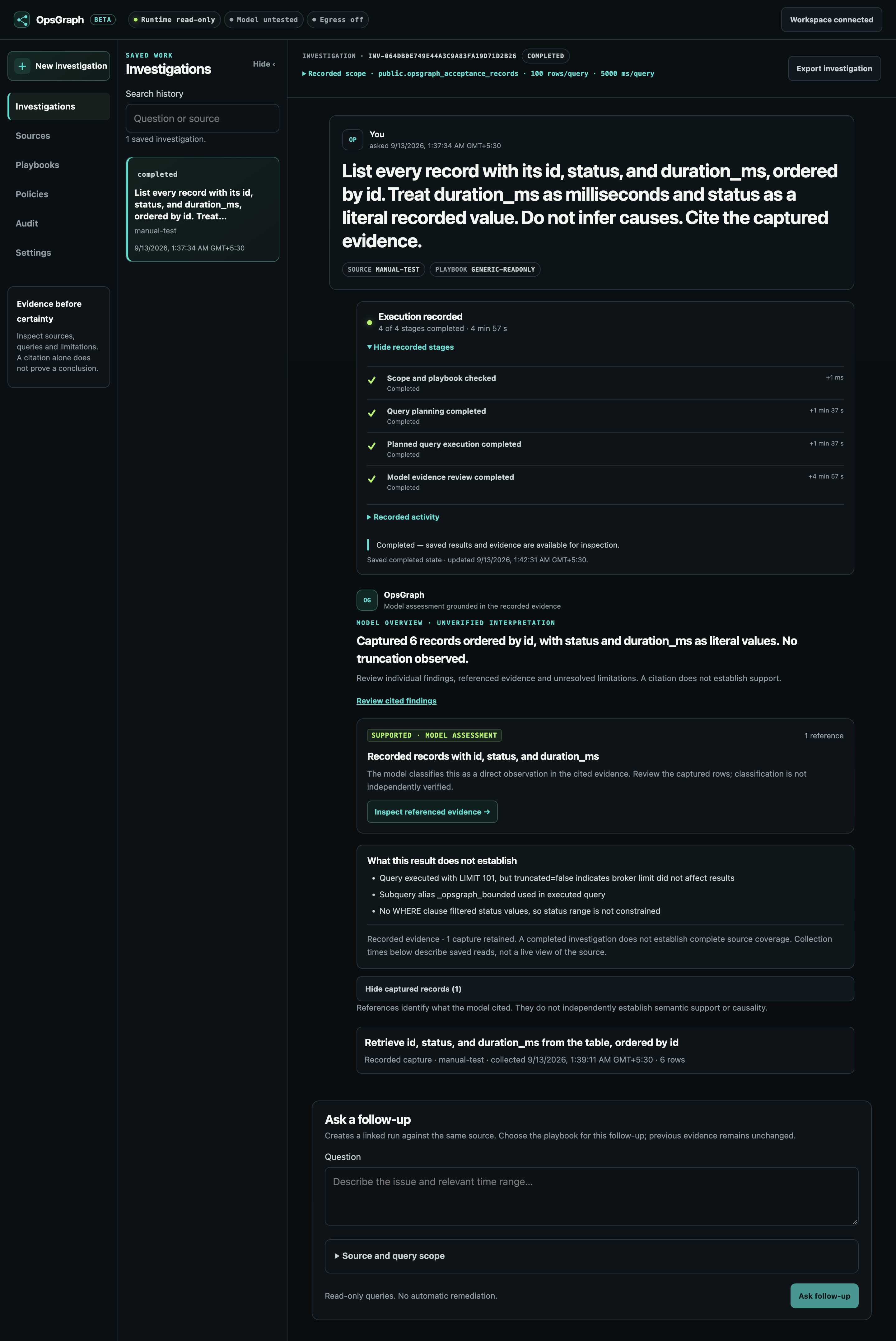
Open referenced evidence to inspect the query, source, collection time, captured rows and limits behind a finding.
OpsGraph is a self-hosted investigation workspace for one operator. Your model plans bounded, read-only queries. Application policy controls their execution.
Built for evaluation on an authorized, non-sensitive PostgreSQL test database. Not production-ready.
 Policy-controlled investigation
A citation does not make a conclusion true. OpsGraph keeps the work inspectable so you can review what was actually queried and captured before you act.
Open referenced evidence to inspect the query, source, collection time, captured rows and limits behind a finding.
Choose explicit schema-qualified tables and use a dedicated read-only role. The model cannot grant itself access or make database changes.
Reopen history, export evidence, retry failed work with fresh queries, or ask a linked follow-up while earlier evidence remains unchanged.
The model can plan. OpsGraph validates and executes inside explicit application policy. Database permissions remain the final authority.
Current beta defaults allow up to three queries, 100 captured rows per query, and five seconds per query. Playbooks may be stricter.
The workflow is intentionally narrow. OpsGraph does not silently invent sample answers, download models, or remediate your database.
Pick a source and playbook. Start with a question whose columns and meanings you actually know.
Your configured model proposes bounded queries against tables you explicitly approved.
AST validation, role checks, approved-table scope and read-only transactions gate execution.
Compare the answer with captured rows and SQL. Review missing evidence and limitations before acting.
A saved investigation can be reopened later. Findings, cited evidence, captured records and limitations remain inspectable, while follow-ups collect fresh evidence.
Use Ollama locally, configure another OpenAI-compatible endpoint, or connect Anthropic with explicit external-data permission. OpsGraph does not download model weights for you.
Tested local path. Keep model inference on your own machine when that fits your workflow.
Point OpsGraph at an endpoint you operate or trust. Provider access stays explicit.
External inference is opt-in. Review data handling before connecting source records.
If you are evaluating OpsGraph, the offline bundle is the shortest path. If you want to modify or contribute, use the source checkout with uv.
# Download the matching v0.1.0b1 bundle + .sha256
# macOS / Linux
python3.11 -I Install.py install
python3.11 -I Install.py launch

# Windows
py -3.11 -I Install.py install
py -3.11 -I Install.py launchgit clone --branch v0.1.0b1 --single-branch \
https://github.com/Arittra-Bag/opsgraph.git
cd opsgraph
uv sync --locked --all-extras
uv run opsgraph launch --configuredocker pull ghcr.io/arittra-bag/opsgraph:beta
# Or from the checkout
docker compose --env-file .env \
-f deploy/compose.yaml up --build -dBeta 1 is a prerelease for public validation. Native installer lifecycles are checked on macOS, Ubuntu and Windows, but validation depth differs by platform. The Docker image has configuration and health checks; a complete container investigation workflow is not yet claimed as verified.
The most useful feedback is technical: execution boundaries, evidence quality, installation friction and operator workflow.